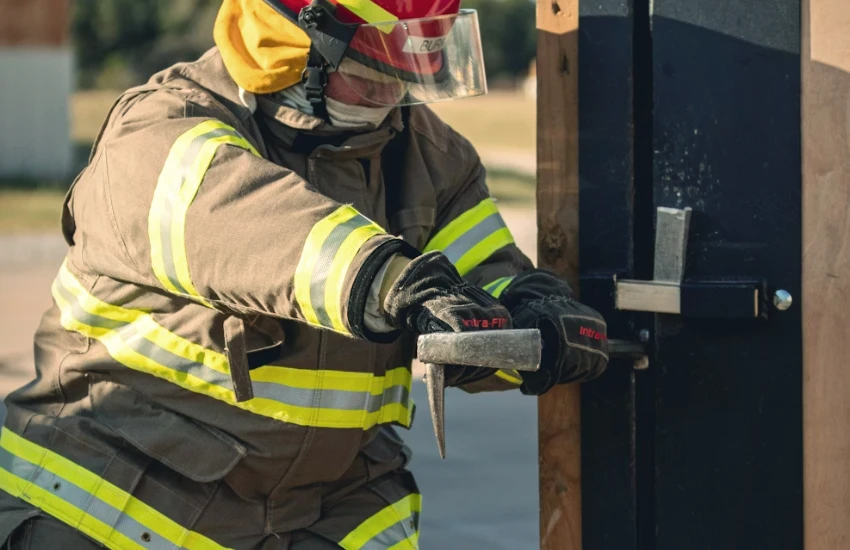
In tactical breaching operations, the ability to quickly identify and assess a door system is critical for operational success. Whether used by fire service teams, SWAT units, or military tactical units, tools such as a hydraulic door opener rely on an accurate understanding of door construction and structural behavior.
This guide provides a technical classification of door types relevant to forced entry, focusing on systems that present real mechanical resistance during tactical breaching.
What Makes a Door Relevant for Tactical Breaching?
A door is considered relevant for forced entry using a door opener when it includes:
- Structural rigidity (wood, steel, or composite construction)
- Mechanical locking systems (single or multi-point locks)
- A fixed frame anchored to the building structure
Excluded Systems:
- Lightweight interior doors
- Glass doors
- Sliding or folding doors without structural resistance
Door Assembly: Key Structural Components
Understanding the door assembly is essential for any tactical unit performing breaching operations.
1. Door Leaf
The moving barrier element.
2. Door Frame
A fixed structural component anchored to the wall (critical in forced entry scenarios).
3. Locking System
Includes:
- Latch mechanisms
- Deadbolts
- Multi-point locking systems
👉 In most tactical breaching scenarios, failure occurs at:
- The lock interface
- The frame-to-wall connection
- The hinge attachment
Classification of Door Types for Tactical Breaching
1. Hinged Doors (Primary Target for Door Openers)
Hinged doors are the most common door type encountered by fire service and SWAT teams.
Characteristics:
- Mounted on hinges
- Locking mechanism on the opposite side
- Defined gap between leaf and frame
Subtypes:
- Solid wood doors
- Steel doors
- Reinforced composite doors
👉 These are the primary targets for hydraulic door opener tools in tactical breaching operations.
2. Solid Timber Doors
Structure:
- Solid or laminated wood construction
Engineering Properties:
- Moderate strength
- No inherent metal reinforcement
Failure Behavior:
- Splitting or shear near the lock area
3. Steel Doors
Structure:
- Double steel panels with internal core (foam or honeycomb)
- Sometimes reinforced at critical
Engineering Properties:
- High stiffness
- Resistance depends on steel thickness and internal reinforcement
Failure Behavior:
- Local deformation near locking
- Frame failure may occur before door leaf failure
4. Security Doors (Multi-Layered Systems)
Widely used in residential and high-security environments.
Structure:
- Multi-layer design (steel + core + outer finish)
- Reinforced lock zone
Engineering Properties:
- Load distribution across multiple locking points
- Increased resistance to forced entry
Important Note:
“Security door” is not a standardized classification — performance varies significantly.
5. Industrial Heavy-Duty Doors
Structure:
- Thick steel construction
- Reinforced hinges and frame
Applications:
- Industrial facilities
- Infrastructure buildings
- Utility and service rooms
Engineering Properties:
- High resistance to deformation
- Designed for repeated heavy use
Locking Systems in Tactical Breaching
1. Single-Point Locking
Characteristics:
- One locking
- Load concentration at a single area
2. Multi-Point Locking Systems
Characteristics:
- Multiple locking along the door
- Vertical rods or distributed bolts
Engineering Impact:
- Load distribution
- Increased resistance against forced entry
3. Full Perimeter Locking
Characteristics:
- Locking engagement on multiple sides of the door
- Common in advanced security systems
Opening Direction and Structural Behavior
Inward Opening (In-swing)
- Frame absorbs external force
Outward Opening (Out-swing)
- Door leaf transfers load into the frame
👉 Opening direction significantly affects force distribution during tactical breaching with a door opener.
Hinges and Load Transfer
Types:
- Exposed hinges
- Concealed hinges
- Heavy-duty hinges
Engineering Role:
Hinges transfer load between the door leaf and the frame and can influence failure behavior.
Door Frames: Critical Structural Element
Non-Structural Frames
- Thin profiles
- Mechanically fastened
Structural (Grouted) Frames
- Embedded in concrete or masonry
- Integrated into the building
Key Insight:
For fire service and tactical units, the door frame is often the weakest point in the system.
Single vs Double Leaf Doors
Single Leaf
- Standard configuration
Double Leaf
- Active leaf + passive leaf
- Passive leaf secured by vertical locking rods
Common Real-World Configurations
| Door Type | Construction | Locking System | Frame Type |
|---|---|---|---|
| Residential entry | Steel/composite | Multi-point | Semi-structural |
| Reinforced interior | Solid wood | Single-point | Light frame |
| Industrial access | Heavy steel | Industrial lock | Structural |
| Public building | Reinforced metal | Multi-point | Variable |
Key Engineering Insights for Tactical Breaching
- A door is a multi-component system, not a single element
- Structural failure occurs at interfaces, not always in the material itself
- Multi-point locks increase resistance but do not eliminate failure
- Frame installation quality is often more critical than door material
Conclusion
For fire service teams, SWAT operators, and tactical units, understanding door types is essential for efficient tactical breaching.
When using tools like a hydraulic door opener, accurate identification of:
- Door construction
- Locking system
- Frame type
directly impacts:
- Entry speed
- Operational safety
- Tool effectiveness


Eu et tellus vestibulum taciti et sit, nunc enim ipsum donec aliquam vitae, per mauris, amet ultrices. Pellentesque amet proin ut vestibulum eleifend nam, wisi vel tellus pulvinar mi risus consectetuer, sed faucibus facilisi, accumsan nam.
Aute mi ut suspendisse velit leo, vel risus ac. Amet dui dignissim fermentum malesuada auctor volutpat, vestibulum ipsum nulla.
Sed reprehenderit quam, non felis, erat cum a, gravida lorem a. Ultricies in pellentesque ipsum arcu ipsum ridiculus velit magna, ut a elit est. Ultricies metus arcu sed massa. Massa suspendisse lorem turpis ac.
Comments are closed.